
Welcome to a journey through time, where past and present mingle in the heart of Spain. Alto Tajo, a hidden natural gem spanning parts of the provinces of Guadalajara and Cuenca, is famous not only for its impressive landscapes and gorges, but also as the guardian of age-old trades that have shaped the identity of this land for centuries.

Traditional Trades in Alto Tajo: A Journey into the Past
On this journey, we invite you to immerse yourself in the rich history of the crafts that have given this region life and character. Prepare to discover a world where manual skill, patience and knowledge passed down from generation to generation have created a unique legacy that we can still admire and experience today.


Gancheros
Imagine for a moment the roar of the River Tagus, its turbulent waters winding between limestone gorges. Now picture brave men on floating logs, skilfully guiding timber downstream. These are the gancheros (river log drivers), the true heroes of Alto Tajo.

The gancheros were responsible for transporting pine logs from Alto Tajo’s lush forests to Madrid, on an epic journey that could take weeks. Armed with long poles tipped with iron hooks, these men braved the currents, rapids and dangerous stretches of the river to ensure the timber reached its destination.
Today, although log drives no longer take place, you can relive this fascinating history every year at the end of August, when a re-enactment of the log drive takes place, a unique spectacle that transports you back to those times of courage and sacrifice.
Discover the memory of the area
Discover the trades, landscapes and memories of Alto Tajo with El Observario. Enquire about an interpretive activity tailored to your group’s interests and pace.
Shepherds
The tinkling of cowbells and the gentle bleating of sheep are sounds that have accompanied the inhabitants of Alto Tajo for millennia. Livestock farming, more than agriculture, has been the pillar of the local economy since time immemorial.
Shepherding, once a key activity in Alto Tajo, has declined in recent decades. Yet its legacy lives on in the traditional architecture dotted across the region’s hills. Enclosures, lambing sheds, shelters and sheepfolds are examples of these structures, but undoubtedly the most emblematic is the Chozón Sabinero.

These circular structures, made of limestone and Spanish juniper wood, served as shelters for sheep and goats. Their presence reminds us of the importance of this trade in Alto Tajo’s history and its role in shaping today’s landscape.
If you would like to discover a group of these structures, here are three ethnographic routes that bring you a little closer to the past of this trade.


Sierra Molina and the Livestock Museum of Checa
Sierra Molina, a vast area within the municipality of Checa, has for centuries been a refuge for traditional livestock farming. Despite the difficulties of the terrain and climate, this activity has shaped the area’s identity.
The Museum of Traditional Livestock Farming in Checa, housed in the village’s former school, pays tribute to this cultural heritage. Through its exhibitions, the museum introduces us to the world of shepherds, their tools, their customs and the deep connection they have maintained with livestock and the natural environment.
However, livestock farming in Sierra Molina faces an uncertain future. Rural depopulation, the ageing of shepherds and the lack of a new generation threaten the survival of this age-old activity. It is therefore essential to value the work of shepherds, protecting their knowledge and encouraging a new generation to ensure the survival of this cultural and environmental legacy.

The Alto Tajo Traditional Livestock Farming Museum in Checa tells the story of the transhumant livestock tradition that sustained this land
View moreThe Land and Its Fruits: Agricultural Trades
Although less prominent than livestock farming, agriculture has left its mark on the landscape and traditions of Alto Tajo. Reapers with their sharp sickles and farmers guiding their ploughs have shaped the fields and valleys of this area for generations.
In villages such as Cobeta and many others, you can still see the threshing floors where grain was threshed and the old watermills that turned cereal into flour. These structures are silent witnesses to a not-so-distant past when manual work was the norm.


Masters of Stone: Sculpting the Landscape
Alto Tajo is a land of rock and stone, and its inhabitants have learned to master this material over the centuries. Stone-related trades have left an indelible mark on the region’s landscape and architecture.
Lime Kilns: Turning Rock into Lime
One of the most fascinating stone-related trades involves lime kilns. These structures, scattered throughout the area, were used to turn limestone into quicklime, an essential material for construction and agriculture.
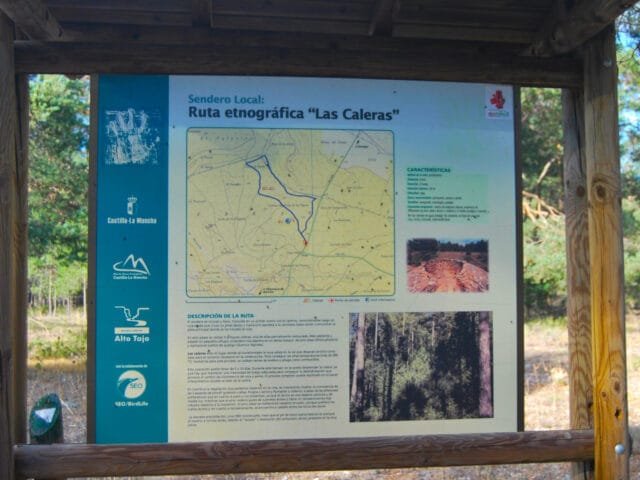
La Ruta de las Caleras, an official park route, takes you past restored old lime kilns. Walking this trail is like stepping back in time, imagining the hard work of the lime burners and the intense heat of the kilns in full operation.
Stone Architecture: The Visible Legacy
Master stonemasons have left their mark in every corner of Alto Tajo. From imposing churches to humble shepherds’ pens, stone is the main material.
In many villages, you can admire outstanding examples of traditional stone architecture. Houses with their distinctive wooden balconies, bridges that defy time and public fountains are silent witnesses to these craftspeople’s skill.

Forging history among the mountains: A tour of Alto Tajo’s ironworks
As might be expected in an area with rich and varied geology, complex terrain and numerous streams and rivers with permanent flows, ironworks or “ferrerías” were not uncommon.
Usually located close to rivers, whose water powered their forges, and using wood from the surrounding hills, their main purpose was to transform the rich iron ore extracted from countless mines, deposits or simple veins scattered across almost all the hills of Alto Tajo.
Iron has always been a much-needed material, although the work of giving this metal the properties needed to make tools or implements was among the hardest of all.

Living examples of the important role this industry played in the area include the Herrería de Peralejos, situated in the bed of the Hoz Seca, and the Herrería del Río Arandilla. Both are still standing and easily visible, though severely deteriorated.
Although we can still see some, many of these buildings were converted into armouries when times demanded it, but this led to their destruction and many have now disappeared completely.
As you have seen, Alto Tajo is not just a destination; it is a journey through time and traditions. Each trade we have explored is a window into a past rich in knowledge and skills that have shaped this land and its people.
We invite you to discover these ancient trades for yourself. Take part in craft workshops, visit local museums and talk to the inhabitants who still keep these traditions alive. Each experience will bring you a little closer to the heart and soul of Alto Tajo.
Come and be surprised by a place where history is felt in every corner, where every stone tells a story and where ancient trades are not just memories, but a living part of this wonderful region’s present and future.